

Musical Instruments

Sacred Sound: The Instruments That Shape Worship at First Presbyterian
First Presbyterian Church is blessed with a multitude of wonderful instruments including three pipe organs: a 56-rank Casavant Frères/B. Rule & Co. instrument in the sanctuary, a 9-rank Baroque chamber organ by Taylor and Boody Organ builders in the chapel, and a 3-rank Martin Ott/B. Rule continuo organ. We also have two historic Steinway grand pianos; A 1924 Model M piano in the sanctuary and a 1937 Model S in the chapel, as well as a 3-rank single-manual Ross/Lebedinsky harpsichord. First Presbyterian church also has an extensive collection of percussion instruments including a full set of Sonar Orff instruments, 3 & 5-octave sets of Malmark Handbells, and a 3-octave set of Malmark Choirchimes.
Chapel Organ
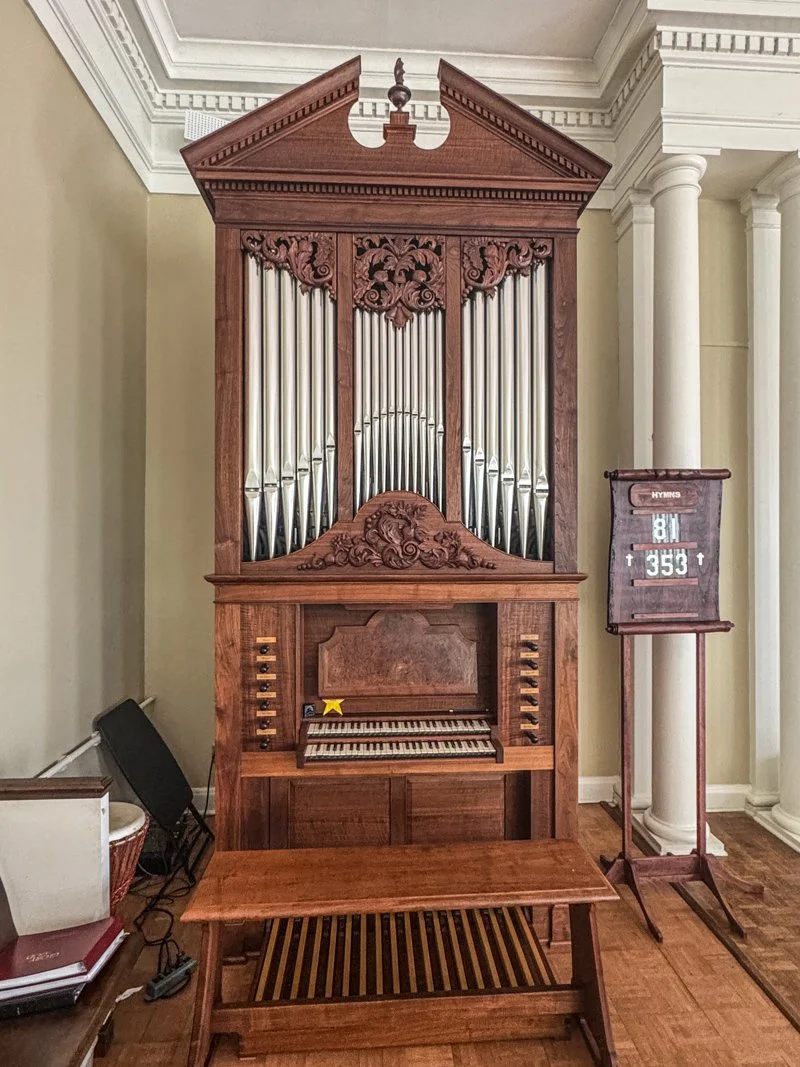
In 2005 for the intimate space of the chapel, Taylor and Boody Organbuilders of Staunton, Virginia constructed their Opus 52, a 9-rank organ in a style typical of a small 18th-century English organ. In fact there is a letter from George Frederick Handel dated September 30, 1749, listing the stops for a chamber organ that he wanted built for his own use. Aside from the pedal stop, which his organ did not have, the stops of the organ are identical to those Handel proposed. An interesting feature of the casework is the wood carvings of classical acanthus leaf designs and turnip plants, recalling First Presbyterian’s history and Knoxville founder James White’s turnip patch, the property on which the church now stands.
Organ Specifications
Great
8’ Open Diapason
8’ Stopped Diapason (borrowed from the Swell)
4’ Principal
2 2/3’ Twelfth (c’)
2’ Fifteenth
1 3/5’ Tierce (c’)
Echo
8’ Stopped Diapason
4’ Recorder
Pedal
16’ Subbass
Couplers: GT/PD, EC/PD
Tremulant

Sanctuary Organ
The sanctuary organ was originally built by Casavant Frères of Saint-Hyacinthe, Quebec, Canada, in 1963. The Casavant Opus 2756 contained 53 ranks of pipes. During the church’s renovation in 2016, the organ was removed, rebuilt, and expanded to 56 ranks by B.Rule & Company from New Market, TN.
The sanctuary Organ was featured in the March 2020 issue of The Diapason and was the cover feature of the February 2026 issue of The American Organist. Check out the article to read the history and specifications of this instrument here.
Continuo Organ
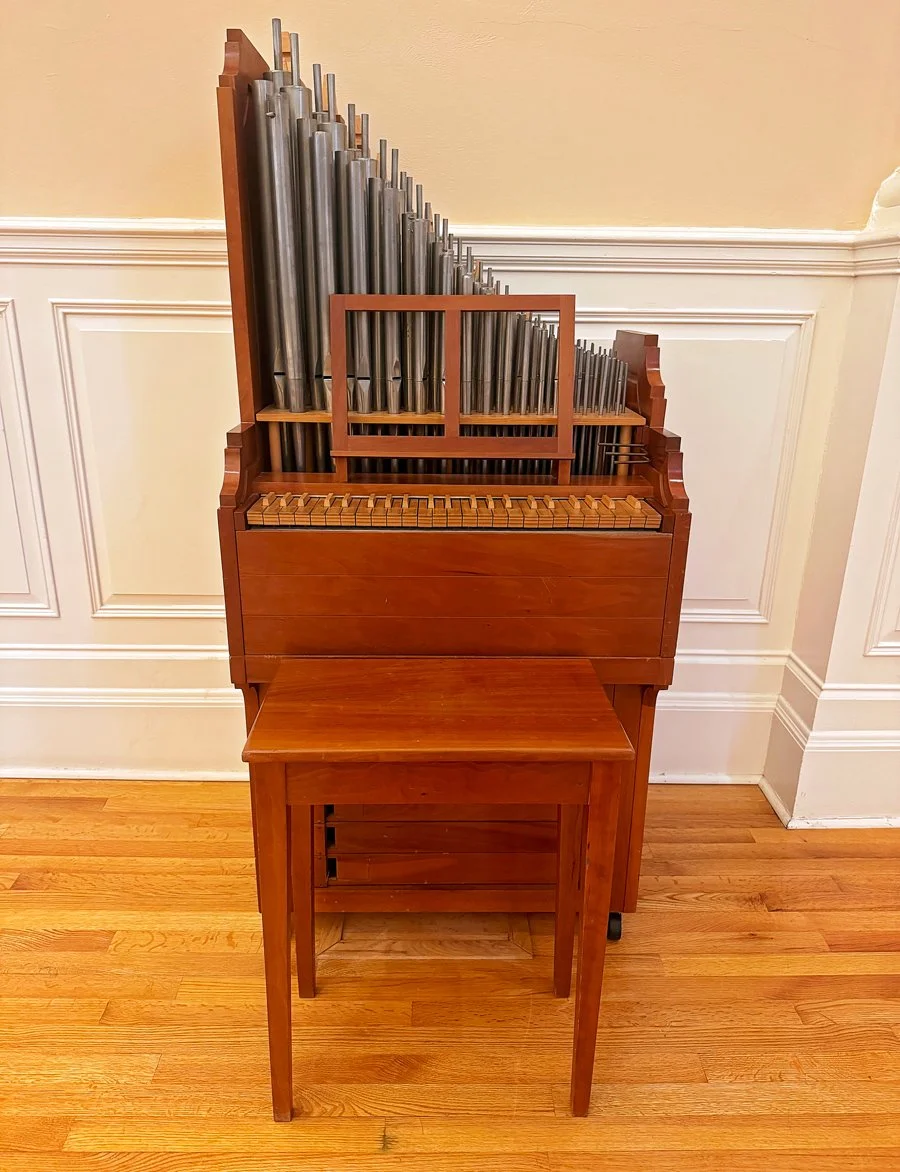
The single-manual continuo organ in the sanctuary was built in 1983 by the Martin Ott Pipe Organ Company of St. Louis, Missouri, and rebuilt in 2016 by B. Rule & Company of New Market, Tennessee. It is especially well-suited for instrumental chamber works as well as accompanying adult and children’s voice ensembles.
The organ was donated to First Presbyterian Church at Easter 1983 to the Glory of God and in memory of Floyd Stevens Roberts by his widow Eula Lee Keisling Roberts.
Organ Specifications
8’ Bourdon
4’ Rohrflöte
2’ Principal
Compass: F-d’’’
Harpsichord
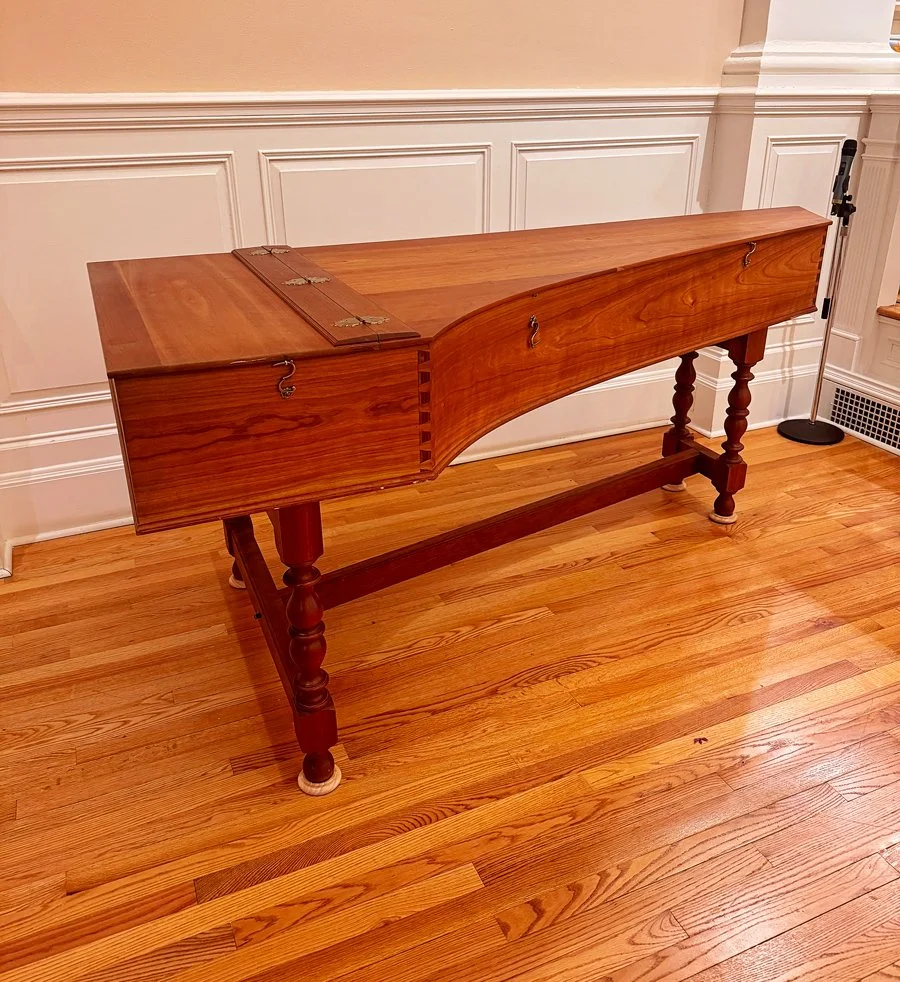
The harpsichord in the sanctuary is a single-manual instrument in the late 17th century Franco-Flemish style. It was built as Opus 40 in 1971 by William Post Ross of Boston, Massachusetts, an important figure in the mid-20th century American harpsichord building revival. The instrument was extensively rebuilt by Henry Lebedinsky of The Harpsichord Shop, Everett, Washington, in 2023. The instrument has an imposing personality and lots of color, with rich contrast between the two 8' choirs and a sparkling 4’. The four-piece turned stand is in cherry, with matching music desk and a reverse keyboard.
Harpsichord Specifications
Compass: 63 keys, FF-g'''
Disposition: 8’, 8’, 4', buff