
A Miraculous Sight!
by Scott Scheetz
The month of February has one of my favorite Sundays in the liturgical calendar; Transfiguration Sunday. This Sunday falls on the last Sunday before Lent, serving as a transition between the Epiphany season and Lent. It celebrates the story of Christ’s transfiguration on a mountain top as found in the Gospels of Matthew, Mark, and Luke.
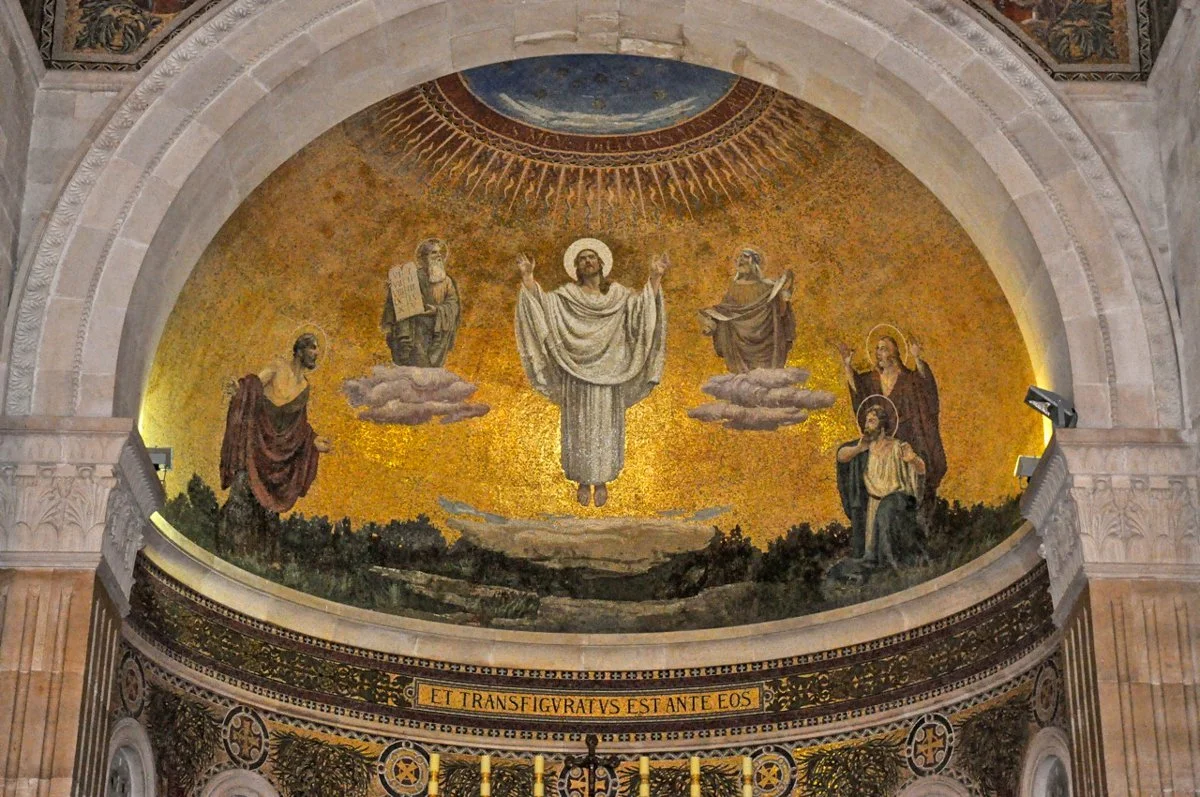
Mosaic at Church of the Transfiguration, Mount Tabor, Israel
In Matthew 16, we find that Jesus and his disciples have just entered Caesarea of Phillipi. People were asking who he was. Some thought he was Elijah or one of the other prophets. Jesus then spent time teaching and foretelling His death and resurrection to the disciples.
After six days, Jesus, along with Peter, James, and John, climb a mountain, [most likely Mount Hermon just outside of Caesarea of Phillipi, but fifth-century custom identifies the mountain as Mount Tabor in lower Galilee, upon which now rests the Church of the Transfiguration, a space shared by Eastern Orthodox and Roman Catholic traditions.] When they reach the top, a bright light surrounds Jesus and his clothing becomes dazzling white. Suddenly, Moses and Elijah appear and begin to talk with Jesus. Peter says to Jesus: “Lord, it is good for us to be here; if you wish, I will make three dwellings here, one for you, one for Moses, and one for Elijah.”
While they are up on the mountain, the voice of God announces “This is my Son, the Beloved; with Him I am well pleased; listen to Him!” The disciples fall to the ground and are overcome with fear. Jesus says, “Get up and do not be afraid”. When they look up, Moses and Elijah have vanished. This event is known as the Transfiguration of Christ as Christ’s glory and divinity was revealed to the three disciples.
My favorite hymn for this Sunday is “O Wondrous Sight! O Vision Fair” (original Latin title: Coelestis Forman gloria), and is found in our Glory to God hymnal as No. 189. This hymn dates back to the late 1400s from the Sarum Breviary used by the Salisbury Cathedral prior to the introduction of the first Book of Common Prayer in 1549. The text for this hymn was translated into English by John Mason Neale in 1851, however his original translation is not what is commonly used, nor is what is found in our hymnal. The translation in our hymnal is from Hymns Ancient and Modern, 1861, which used only part of Neale’s translation, and combined it with other English translations.
O wondrous sight! O vision fair
of glory that the church shall share,
which Christ upon the mountain shows,
where brighter than the sun he glows!
From age to age the tale declares
how with the three disciples there
where Moses and Elijah meet,
the Lord holds converse high and sweet.
The law and prophets there have place,
two chosen witnesses of grace;
the Father's voice from out the cloud
proclaims his only Son aloud.
With shining face and bright array,
Christ deigns to manifest that day
what glory shall be theirs above
who joy in God with perfect love.
And faithful hearts are raised on high
by this great vision's mystery;
for which in joyful strains we raise
the voice of prayer, the hymn of praise
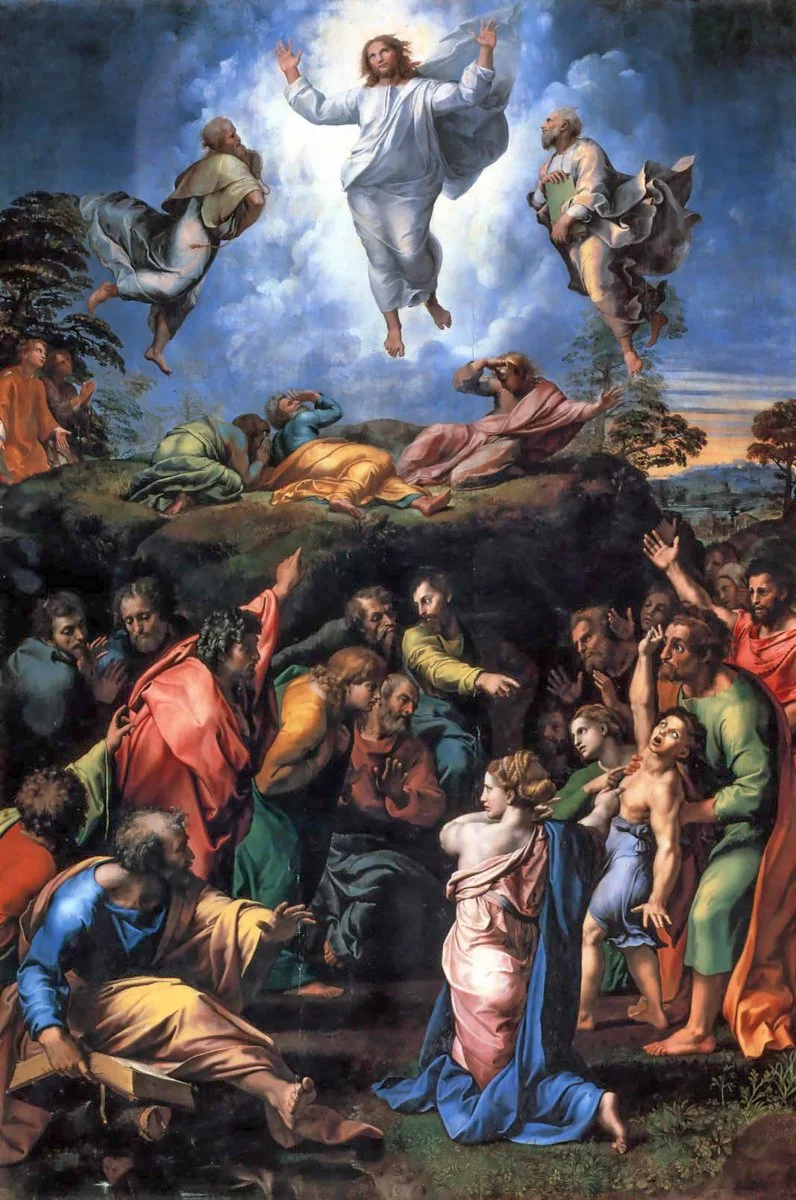
Transfiguration by Raff aello Sanzio da Urbino Oil tempera on wood, 1516-1520
With hymn texts of this age, it is difficult to know what music would have been sung to as typically only the words are written down. Usually there would be a book of words (a hymnal), and a tune book. Oftentimes texts would be sung to well known tunes of the time. The meter and rhythm of the text would be paired and sung to a tune that matched.
In more modern hymnals, this beautiful text is typically paired with the tune DEO GRACIAS, also known as AGINCOURT. This tune is an English ballad melody originating from the early 1400s and was used in celebrating the victory of an English king. As the text and tune date from a similar era, there is the possibility that they could have been paired together at some point centuries ago.
There are two interesting things that come from this pairing. The first is from the tune's origin as a song of celebration for a king. This combination is well suited for representing the disciples awe and wonder as Christ’s divinity and glory were revealed to them. Secondly, this musical pairing with a martial tune of a king’s victory in battle beautifully foreshadows what is to come. The story of Christ’s transfiguration ends with Jesus talking to his disciples about prophecies of Elijah rising from the dead [who was said to return before the Messiah - Malachi 4]. He tells them “How then is it written about the Son of Man, that he is to go through many suff erings and be treated with contempt? (Mark 9:12)”. Shortly after this, “Jesus set his face to go to Jerusalem” (Luke 9:51). The time was near when Christ would be crucified, and then rise from the dead gaining victory over death.
This hymn text not only retells the transfiguration story, but it invites us to take part in it. The fourth stanza states that the glory of Christ will someday be for all “who joy in God with perfect love.” We are invited in the final stanza that all faithful hearts should raise a joyful hymn of praise.
Soli Deo gloria!