
How to Sing?
by Scott Scheetz
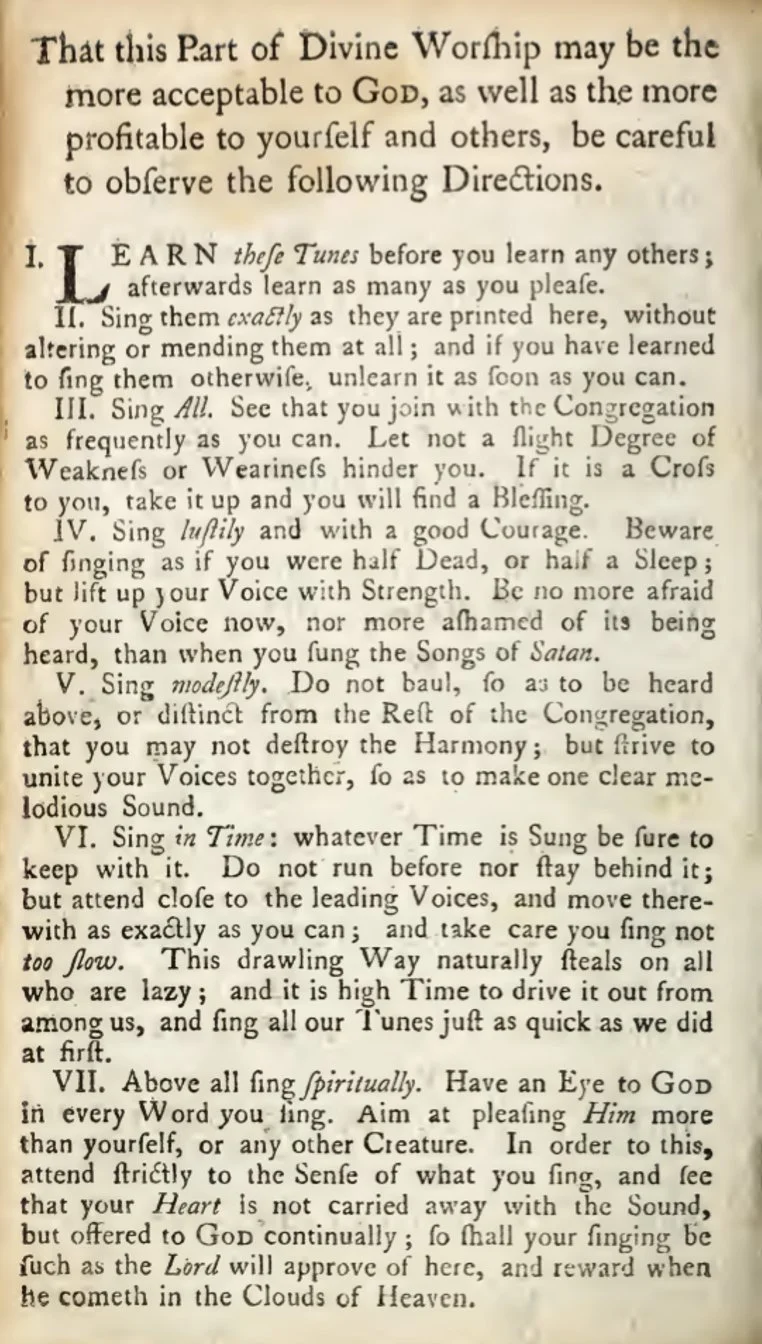
“Directions for Singing” from John Wesley’s Select Hymns, 1761
Music and singing is an important and long standing part of the Christian worship service, and I’d like to take a moment to talk about how to sing. Don’t worry, this won’t be a technical description of how the sound is produced, nor will it be a study of music theory and notation. Just simply, how we should engage in song as we worship.
Having attended seminary at Southern Methodist University and spent many years in the Methodist churches, I have a fondness for John and Charles Wesley’s writing and their contributions to the church. For those who aren’t familiar with the Wesleys, they are essentially the founders of the Methodist Church. John was a pastor and his brother Charles was a very prolific hymn writer who wrote over 8,900 hymns!
In 1761, John published a collection of 133 hymns in a book entitled Select hymns with tunes annext: designed chiefly for the use of the people called Methodists. At the end of this collection, John included “Directions for Singing”. Although there are only seven brief instructions, we can see just how important music in worship was to John, and how important music in worship should be for us as well. These directions were so significant, they are still included in the United Methodist Hymnal today, and can be found on page vii of the preface. These directions are at times humorous, odd, and insightful. Some apply more specifically to the collection that they were written for, however all are still very applicable today, over 250 years later.
That this part of Divine Worship may be the more acceptable to God, as well as the more profitable to yourself and others, be careful to observe the following directions.
I. Learn these Tunes before you learn any others; afterwards learn as many as you please.
The first rule may seem strange, but when put in the context of the original hymnal and other hymnals of the time, it begins to make sense. Older hymnals only had texts printed and its rhythmic meter. There were no notes. There were other books which were just the music (the hymn tune), and you would pair the text and the tune based on the rhythmic meter. Sometimes, the text would be paired with a tune the local congregation already knew and the tune book wouldn’t even be referenced. This new hymnal by John Wesley was the first collection of hymns and tunes specifically chosen for the new Methodist Church and for all churches practicing Methodism. These carefully chosen hymns were establishing and reinforcing the Methodist doctrine and bringing unity to those churches. John wanted to be sure that people were united in song, and that each hymn text was paired with the same hymn tune from congregation to congregation.
Imagine if you went to five different churches all in the same denomination and each sang Amazing Grace, but the tune was different at each church. Or if one church sang the same hymn five weeks in a row, but each time the hymn tune was different. It would be difficult to learn the hymns and find unity in congregational song. The uncertainty and inconsistency of the music would get in the way of making a joyful noise to God in worship, and probably lead to people singing less.
This instruction is also interesting and valuable as it says that our song to God doesn’t need to be limited by the constraints of a single hymnal. The use of a hymnal is important for solidifying the musical and theological identity of a congregation, but it’s also good to use songs from other denominations, languages, and cultures as all are equally important in praising God and can remind us of the global unity we find in Christ!
II. Sing them exactly as they are printed here, without altering or mending them at all; and if you have learned to sing them otherwise, unlearn it as soon as you can.
This one is fairly amusing. John is essentially saying, sing the right notes and if you sing a wrong one, fix it! This also implies that if you learned a hymn text to a different tune, only use the tune in this hymnal.
III. Sing All. See that you join with the congregation as frequently as you can. Let not a slight degree of weakness or weariness hinder you. If it is a cross to you, take it up and you will find a blessing.
This is my second favorite of the directions. Everyone is called to sing and make a joyful noise to the Lord, and we find this calling throughout scripture. For those who are self-conscious about singing alone, singing with a group can reduce the pressure and anxiety of singing and allow one’s self to more fully be blessed by music and worship.
IV. Sing lustily and with good courage. Beware of singing as if you were half dead, or half asleep; but lift up your voice with strength. Be no more afraid of your voice now, nor more ashamed of its being heard, than when you sung the songs of Satan.
I am sure we can all relate to the first half of number four. We all have those mornings (even on Sundays), where we are physically or emotionally tired. Sometimes it’s both. We are called to join in praise and song as we worship, and by joining together, we gain strength and energy as one voice.
The second half of that one is both funny and a bit odd and I have to remind myself that it was written in the 1700s. The “Songs of Satan” as John Wesley puts it, is simply secular music, and secular music isn’t necessarily a bad thing. I’m sure we all have that favorite song that we sing loudly in the shower or sing along to in our cars when it plays on the radio. I will fully admit that if Taylor Swift’s Shake If Off starts playing, I’m going to be singing along and grinning the entire time. Wesley is simply inviting us to have at least that much joy and energy, if not more when we sing our praise to God.
V. Sing modestly. Do not bawl, so as to be heard above or distinct from the rest of the congregation, that you may not destroy the harmony; but strive to unite your voices together, so as to make one clear melodious sound.
No matter what music ensemble I’m leading, whether it’s a vocal or an instrumental ensemble, I always remind them that the most important part of making music together is listening. It’s the same as when people are having a spoken dialogue. Everyone’s voice is important and should be heard, as what we make together is often more fulfilling and beautiful than what we make alone.
VI. Sing in Time: whatever time is sung, be sure to keep with it. Do not run before nor stay behind it; but attend closely to the leading voices, and move therewith as exactly as you can. And take care you sing not too slow. This drawling way naturally steals on all who are lazy; and it is high time to drive it out from among us, and sing all our tunes just as quick as we did at first.
Again we have the reminder to listen and sing together and to sing with energy. We should never be lazy in our song and praise to God as we are called to give our first fruits (or our best) to Him!
VII. Above all sing spiritually. Have an eye to God in every word you sing. Aim at pleasing him more than yourself, or any other creature. In order to this attend strictly to the sense of what you sing, and see that your Heart is not carried away with the sound, but offered to God continually; so shall your singing be such as the Lord will approve of here, and reward when he cometh in the clouds of heaven.
Finally, my favorite of the seven instructions. As the Wesleys’ often do, they save the best for the last and point us toward God in heaven. This is a motif that Charles Wesley commonly uses in his hymns. He will take us from the muck and mire of human life in the middle verses and remind us of God’s grace and salvation and the promise of life in heaven in the final verse. So let us all sing loudly and joyfully each Sunday as we worship God, offering him the best that we can together as a family of God.
Soli Deo gloria!